Future
superiority
From Riyadh …. The future is here
Contents
Traditional Demand (Global Economy and Population Growth)
- · Clean energy meets the entirety of the new demand for electricity and halts the growth of fossil fuel generation.
- · Solar energy achieves its highest growth rate in eight years, with continued momentum.
- · A historic decline in fossil fuel generation in China and India.
- · Renewable energy outpaces coal for the first time in the modern era.
- · Re-New Investment Bank
AI Demand and Data Centers (Explosive Growth)
- · Renewable energy in the Kingdom.
- · Natural gas.
Today, the global energy structure faces the challenge of 'Critical Duality'; where the pressure of traditional demand to keep the economy's lifeblood pulsing collides with the dense energy explosion imposed by the AI revolution.
Between the needs of traditional consumption and the ambitions of Artificial Intelligence, a structural engineering gap emerges, necessitating a comprehensive reshaping of the electrical power balance—a role the Kingdom must undertake as a strategic center of gravity. Energy security is no longer a mere equation of generation; it has become the stability engineering of two distinct poles: the world's existing economy, and the upcoming digital global mind."
The energy race is not a race toward clean energy; it is a race to determine who will own the means of production in the coming economy.
Nations that grasp this distinction build factories, research institutes, and industrial policies. Nations that do not grasp it build solar plants, announce investment figures, and call it a transition.
The most common strategic fallacy in global discourse is treating the energy race as an environmental challenge or an investment opportunity. It is, at its core, a shift in the structure of international power. Those who do not read it through this lens will find themselves a decade later in the position of one who sold their product to those who sell them the alternative today, then bought that alternative back from the old buyer under new terms.
The window has not yet closed. However, those who delay real industrial decisions for another decade may find that technical standards and supply chains have petrified, making entry expensive to the point of practical impossibility. The difference between those who enter the race today and those who enter it in ten years is not a difference in timing; it is a difference in the nature of the available role.
Everyone is talking about Artificial Intelligence now, but only a very few have the slightest idea of what is coming. There are compute clusters ranging from $10 billion to $100 billion, reaching up to trillion-dollar clusters. Yet, few talk about or know what is coming, which is the AI infrastructure and its cornerstone: electrical power. There is only one country prepared and aware of what is coming, and that is China.
If Riyadh starts now, we will be lucky to compete with Beijing over the next decade. But if we delay, we will have to compete with the United States and Europe just to catch up with Beijing. Just as Riyadh was a fundamental pillar in the infrastructure of the pre-AI economy, it must be among the…
If we are predicting the future correctly, even slightly, we are facing a completely different future.
So ,let me tell you what we see.
Clean energy meets the entire new demand for electricity and halts the growth of fossil fuel generation.
Thanks to record growth in the solar sector, low-carbon energy production rose by 887 TWh in 2025, surpassing the growth in global electricity demand of 849 TWh. Solar energy alone met 75% of the net increase in demand. Together, solar and wind energy contributed to meeting nearly 99% of the demand growth. For the first time since the COVID-19 pandemic in 2020, and for only the fifth time this century, fossil fuel generation saw no increase; instead, it recorded a slight decrease of 38 TWh (-0.2%).
Solar energy achieves its highest growth rate in eight years as its rapid ascent continues.
This new solar generation is sufficient to displace the gas used in electricity production equivalent to all LNG exports through the Strait of Hormuz last year, estimated at 550 TWh.
Solar capacity doubles approximately every three years, rising from 1,333 TWh in 2022. In 2025, solar energy outperformed wind energy globally for the first time and closed in on nuclear energy, with both (solar and wind) expected to surpass nuclear energy in 2026.
Historic Decline in Fossil Fuel Generation in China and India
The main driver of the global decline in fossil fuel generation was the historic shift in trends within China and India, which are the world's first and third largest consumers of fossil fuels in the energy sector.
In China: Fossil fuel generation decreased by 56 TWh (-0.9%), marking the first decline since 2015. Record additions of clean energy (especially solar) pushed the growth of low-carbon sources to outpace demand growth.
In India: A record surge in solar and wind power generation, supported by strong hydroelectric output and lower-than-average demand growth, led to a decrease in fossil fuel generation by 52 TWh (-3.3%).
Renewable Energy Outpaces Coal for the First Time in the Modern Era
- 01For the first time in 100 years, renewable energy (33.8%, 10,730 TWh) outperformed coal power (33.0%, 10,476 TWh) in the global electricity mix.
- 02Coal-generated power decreased by 63 TWh (-0.6%) in 2025.
- 03Coal's share fell below one-third of global production for the first time in history.
Note: The "others sources" percentage and value are derived from the remaining portion of the total mix (100% − 33.8% − 33.0% = 33.2%). The TWh value is estimated based on the proportional share relative to the other two categories.
Toward a new era of energy security
The world is now entering an era of "Clean Growth" and transitioning out of the era of "Fossil Fuel Growth" in the power sector. The abundance of clean electricity enables the electrification of other sectors, such as transportation, thereby reducing reliance on fossil fuels across various economic pillars.
This structural shift arrives at a pivotal moment for the global energy system. Following two major fossil fuel shocks within four years—the Russian invasion of Ukraine and, more recently, the American-Israeli conflict with Iran—the fragility of a system dependent on volatile fuel markets has become crystal clear.
This phase underscores that economies accelerating the expansion of clean energy will be the most capable of securing their domestic energy base and supporting long-term economic growth through a permanent path toward energy security. Total global electricity demand is projected to reach 57,140 TWh by 2050, compared to 29,500 TWh in 2023.
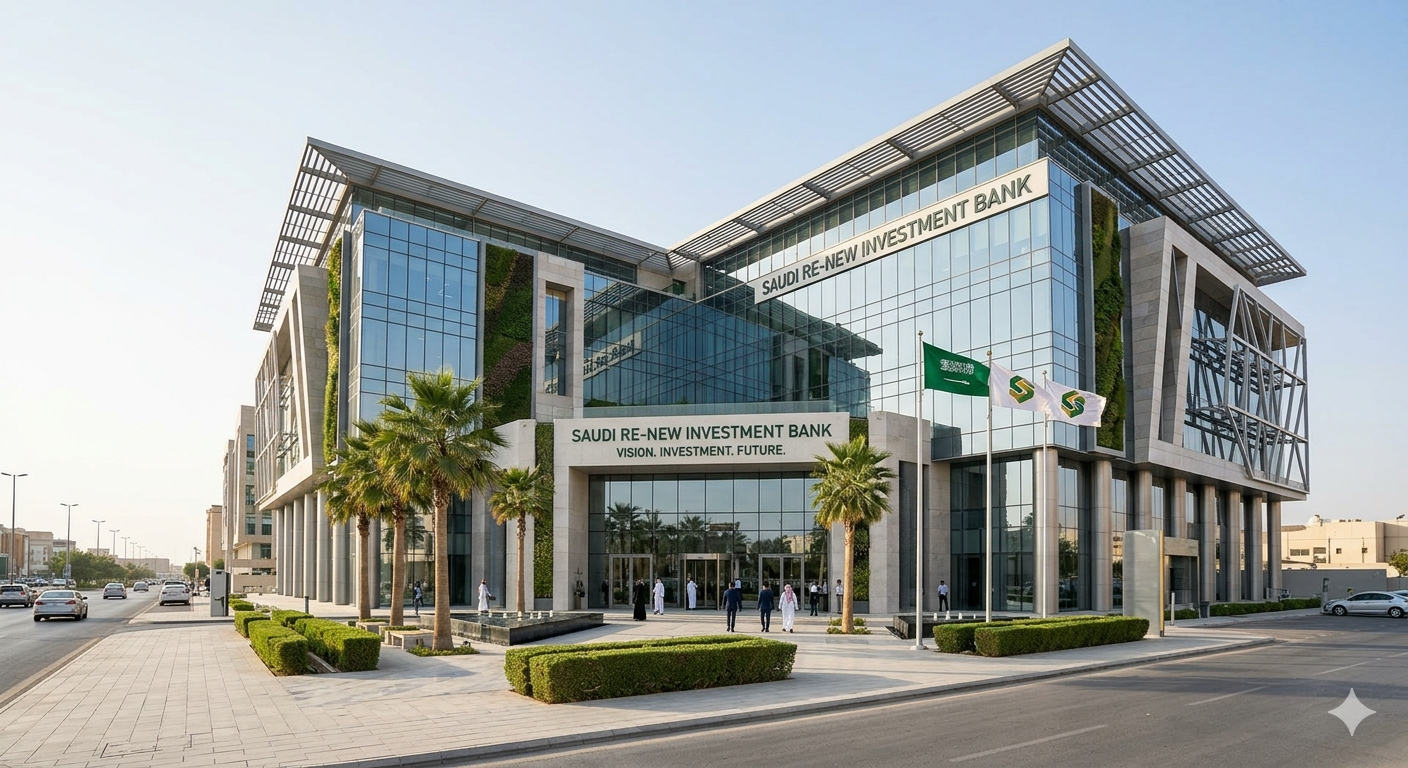
Re-New Investment Bank
Energy
Investment
Bank
Saudi Arabia must adopt a "Transboundary Leadership" strategy to address the crisis of conventional energy demand by establishing the "Re-New Investment Bank." This entity serves as the financial nerve center connecting global capital abundance with the urgent energy needs of Africa and the Middle East. Through its operational arms and international branches, the bank functions as an engineering platform that brings together energy giants and sovereign ministries to transform existing generation gaps into major renewable and thermal power plant projects.
This approach transcends traditional financing into the realm of "Mutual Benefit Engineering." The Kingdom contributes to bridging the electricity deficit in developing continents in exchange for securing global supply chain stability and creating investment opportunities with sustainable returns. Through this "Credit Bridge," the Kingdom becomes the primary regulator of the conventional energy market, achieving a strategic balance that ensures the flow of energy as a fundamental lifeline for the global economy while cementing its status as a guarantor of development in regions most in need of growth.
The core pillars of this vision:
Regional branches acting as direct channels for implementation and oversight across Africa and the Middle East.
Forging tripartite partnerships involving the investor, the implementing company, and the local government.
Investing in the "Energy Mix" (renewables for sustainability and thermal power to ensure baseload stability).
Transforming the challenge of energy poverty in developing nations into a safety valve f
AI demand and data center (explosive growth).
Just as Riyadh was the structural pillar upon which the global economy's infrastructure relied in the last century, it is imperative today that it becomes the sovereign host for the global Artificial Intelligence infrastructure for the coming century. Localizing this infrastructure in the heart of the Kingdom is not merely a technical race, but rather the possession of a strategic deterrent, granting the Kingdom control over the engine of existence in the digital age
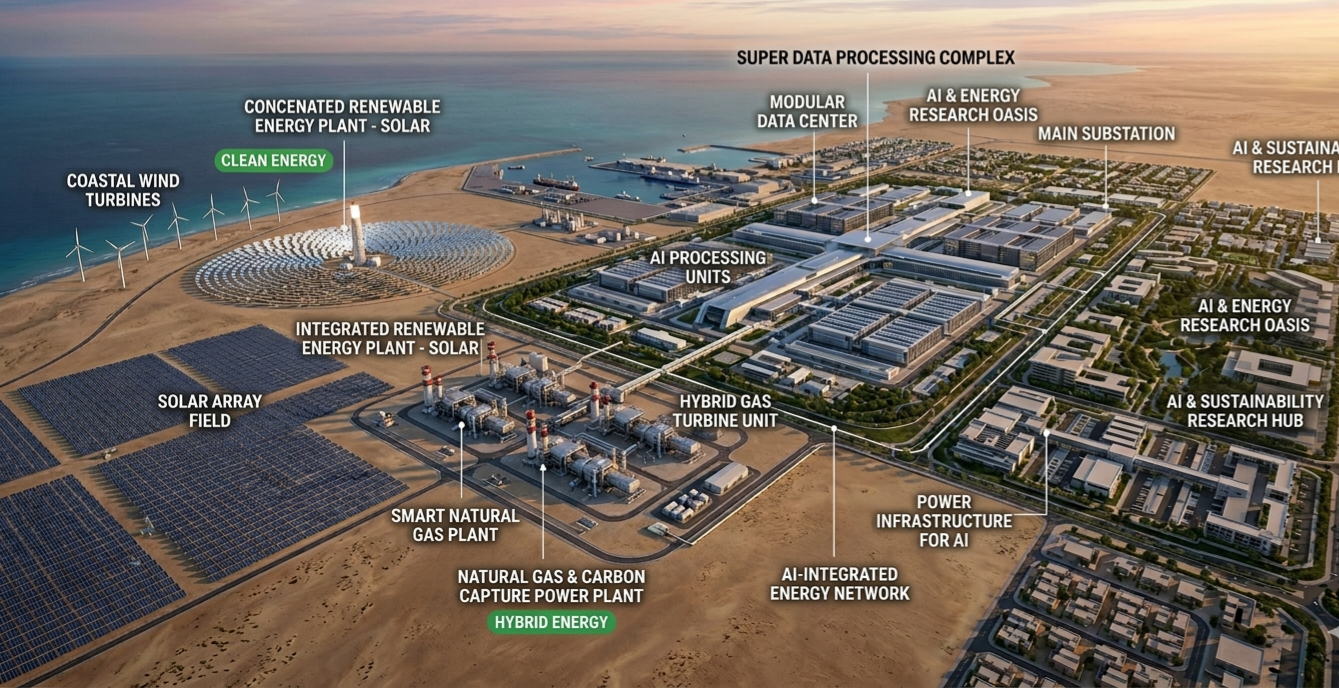
Today, the Kingdom of Saudi Arabia stands at the heart of the global technological and energy transformation, having launched the world's largest renewable energy geographical survey project, covering an area of 850,000 square kilometers; an area comparable to the size of entire countries. It aims to localize Artificial Intelligence cities and their infrastructure in regions with exceptional solar radiation, such as Riyadh, Qassim, and the Northern and Western regions.
In parallel, the Kingdom's natural gas production has surged to a record level of 121.5 billion cubic meters (according to 2024/2025 data), ranking it eighth globally.
Based on these updated and realistic figures for the year 2026, here is the technical and quantitative analysis of what these resources can produce to power the AI revolution:
Solar Energy Potential
This vast area is not just a number, but an "inexhaustible energy reservoir". Technically, the production capacity is calculated based on current operational efficiency:
To produce 1 gigawatt of solar energy, we need an area ranging between 20 to 25 km².
Since Artificial Intelligence requires energy around the clock, and the solar capacity factor in Saudi Arabia is approximately 30%:
Natural Gas Potential
To build modern combined cycle power plants using natural gas in the Kingdom:
Every cubic meter of gas produces approximately 6.3 kWh of electricity.
121.5 billion m³ × 6.3 = 765.4 billion kWh (terawatt-hours) annually.
The continuous production capacity in gigawatts reaches 87.4 GW.
This capacity (87 gigawatts) results from current annual production, and the Kingdom aims to increase gas production by 80% by 2030, which means this capacity alone will exceed 150 gigawatts from gas in the future.
The Kingdom of Saudi Arabia is capable of meeting the 137 gigawatt requirement for the year 2035 using:
The Kingdom of Saudi Arabia does not only possess space and fuel, but also the "competitive cost advantage".
While the world faces a crisis in providing power for data centers, the Saudi geographical survey area and growth in gas production provide the Kingdom with a capacity that exceeds AI needs for 2035 by at least 75 times. This makes it the only logical destination for building the next "Silicon Valley" based on clean and sustainable energy.